
Pet Photo Frame Orders: Keep Portrait Pairs Together
Keep the two intended pet portraits under one pair identifier for each frame order line. Record the selected frame, the two image asset references, the required frame quantity and the agreed supply state. First establish whether the supplier offers an empty frame, inserted pictures or a separately agreed printing task. A two-sided display description does not establish a personalised-photo service.
Settle the offered photo task first
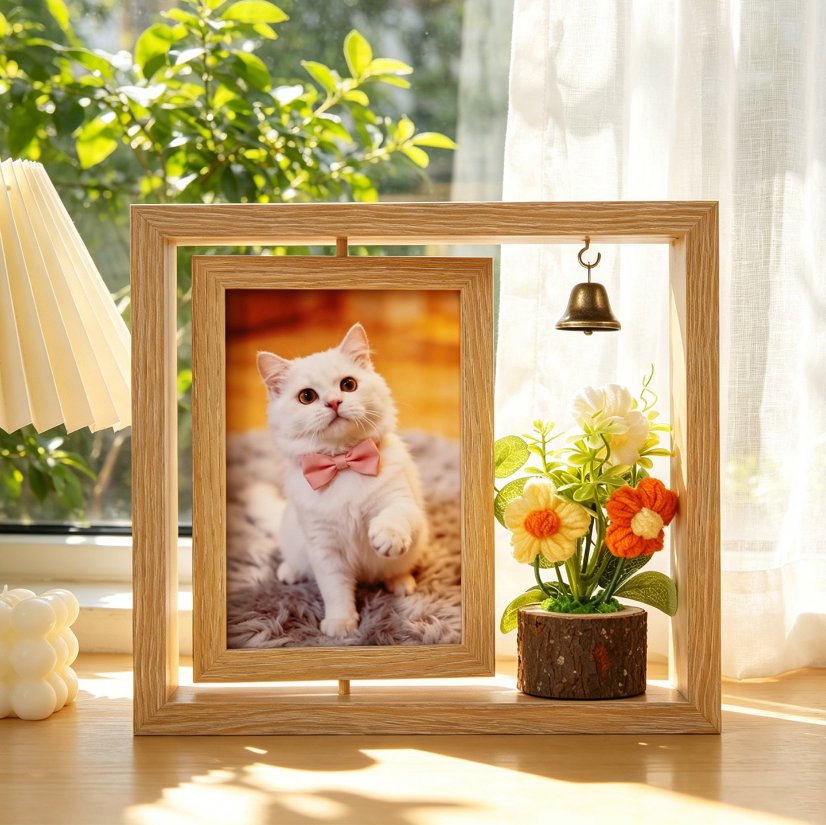
The Qingen catalogue describes a double-sided rotating pet photo frame with photographs on both faces. That gives a buyer a reason to ask about paired images, but it does not say who will prepare or insert them. An empty frame and a frame delivered with selected pictures are different purchasing instructions. Keep that distinction visible before sending files.
Ask which task the supplier is actually quoting. If only an empty frame is offered, the pairing sheet can remain with the buyer or the team that inserts the pictures later. If a supplier agrees to handle images, obtain a response covering that specific task. Do not extend a general custom-colour statement into an assumed image-printing or fulfilment capability.
• Empty frame only, with no picture-processing instruction
• Picture insertion only if expressly offered and agreed
• Printing or another image service only under a separate confirmed scope
Give each complete pair one order-line identity
Assign a pair identifier before distributing individual files. Put it beside the order-line reference and the selected frame variant. The identifier should stay with both image assets even if the working folder changes. A helpful filename can assist the process, but a filename alone is a weak record when buyers rename files or send replacement attachments.
Record which image belongs to each face using an agreed naming convention. A labelled reference view can explain what face A and face B mean for the selected frame. This is a way to keep two assets together, not a statement about a printing surface or the construction of the moving assembly. Those questions belong to their own supplier responses.
Keep image count separate from merchandise quantity. A pair contains two image references; it does not automatically mean two frames. If the same accepted pair is requested for several frames, record that frame quantity on the same line. If different recipients need different pairs, use separate lines rather than leaving the supplier to interpret a mixed folder.
Use a pairing sheet that exposes unanswered fields
The sheet below is a request structure, not a description of an existing supplier system. Agree the identifiers and response format with the party carrying out the task. A field that has no answer should retain a visible pending status rather than borrowing an answer from a neighbouring order line.
Record | Buyer supplies | Response to retain
Pair and order line | One pair identifier linked to the chosen frame variant | Acknowledgement of the same line and variant
Face A asset | The exact asset reference and its accepted revision | Receipt and the agreed face label
Face B asset | The second asset reference, without substituting a similar file | Receipt and any missing-file exception
Frame quantity | Number of frames requested for this complete pair | Quoted supply unit and quantity acknowledgement
Supply state | Empty frame or a specifically requested image task | Supplier confirmation or explicit exclusion
Hold incomplete pairs without inventing a substitute
A folder can contain an attractive photograph and still be incomplete for the requested order. If one face has no accepted asset, mark the affected pair as incomplete and ask the buyer to resolve it. Do not repeat the available picture on both faces, select another pet image or treat a catalogue photograph as a replacement unless that choice is explicitly approved.
The exception should identify the pair, the missing or disputed field and the person expected to respond. It need not stop unrelated complete lines if the commercial parties agree to handle them separately. Equally, do not describe an incomplete line as released merely because its frame style has already been selected.
When a replacement portrait arrives, update the affected asset reference and preserve the earlier record with its superseded status. Confirm whether its partner image remains unchanged. Asking for the complete intended pair in one response is often clearer than comparing several messages and assuming that the latest attachment replaces every earlier decision.
Hand over the agreed pair and the agreed scope together
Before handing a line to the next team, check that both referenced assets are available through the agreed transfer method and that their identifiers match the sheet. Keep access arrangements appropriate to the parties involved; this article does not establish a supplier file-storage policy or a particular software workflow.
Retain the acknowledgement beside the frame reference and the requested quantity. If an empty-frame order later becomes a request for inserted pictures, treat the changed task as a question for agreement. Do not quietly add it to an earlier quotation. Catalogue bells, plants and displayed photographs should likewise not become supplied items simply because they appear in the product scene.
A useful handover lets the next purchaser answer a concrete question: which two accepted assets belong together for this frame line, and what work has actually been agreed? It does not replace physical sample review, create a print-quality guarantee or establish rights to reuse a catalogue image.
Frequently asked questions
What if the supplier sells only empty frames?
Keep the order as an empty-frame purchase. Use the pairing record with whoever later handles the pictures, and do not describe image insertion or printing as part of the supplier offer.
Can one file intentionally be used on both faces?
Yes, if that is the buyer instruction and the relevant party accepts it. Record the same asset reference in both face fields so the choice is explicit rather than an undocumented substitute.
What should remain pending when one portrait changes?
Keep the changed asset and its pair status pending until the replacement and the unchanged partner are clearly acknowledged. Do not infer acceptance from an unrelated frame-style or quantity confirmation.
Product and contact references
Pet photo frame product reference: https://qeframe.com/product/double-sided-rotating-pet-photo-frame/
Discuss the offered supply task: https://qeframe.com/contact/
Qingen procurement articles: https://qeframe.com/blog/