
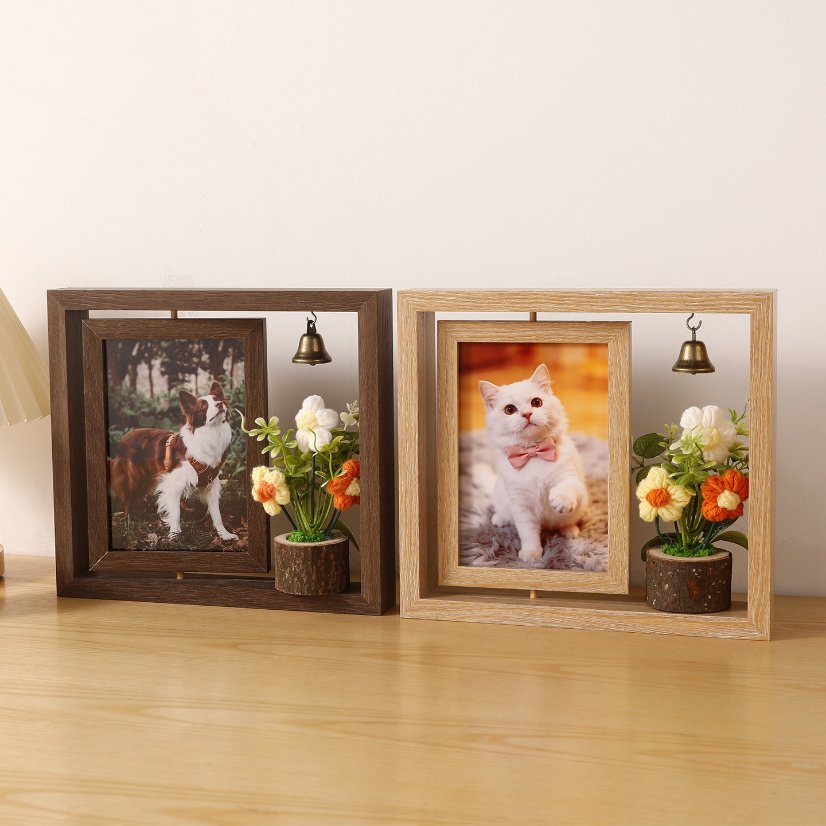
An overall depth statement needs an identified product configuration and a defined front-to-back span. For the historical double-sided rotating pet-photo-frame offer, the buyer should first ask whether the supplier actually declares that dimension. Only then should the enquiry request the named front and rear references, included projections and stated reference configuration. The catalogue title and product photograph cannot supply a depth value or decide which parts the supplier counts.
Identify the supplied whole-frame configuration
Connect the enquiry to the supplier’s exact product or offer reference and its applicable revision. Ask which supplied whole-frame configuration the depth statement describes. A product name can identify the enquiry without defining every component in the commercial offer. Keep configuration not identified separate from a confirmed version rather than completing the record from the assembled catalogue scene.
The supplier’s own component terminology matters. A reference to a body, display or support should retain the meaning and applicability actually stated by the supplier. Do not assume a base or decorative element is supplied merely because a general frame description mentions it. The depth record needs the boundary of the identified offer, not an invented component schedule.
Confirm that a depth statement exists
Ask whether the supplier provides an overall front-to-back depth for that named configuration. If no statement is supplied, record no depth declaration. Do not estimate a value from the image or borrow a dimension from another frame. A missing declaration is a useful purchasing state because it identifies the next supplier answer required.
Where a dimension is actually provided, retain the supplier’s literal term, unit and attributable reference. This article supplies no dimension or conversion. A unit that is not stated remains unresolved rather than being inferred from another document. Keep the declaration linked to its applicable version so it cannot silently migrate into a different product configuration.
Request the front and rear references
For an existing depth statement, ask which supplier-named front and rear extremities define its span. Preserve the description or marked reference actually supplied. Do not choose endpoints on the supplier’s behalf or treat the most visible image features as a validated datum. The word overall does not establish a universal definition for this particular offer.
If the supplier identifies the whole product but leaves its endpoints unclear, retain endpoints unconfirmed. That gap is different from having no depth statement at all. It allows a purchasing colleague to preserve the existing declaration while directing the next enquiry to its missing reference boundary, without creating a new dimensional specification.
Separate included projections from assumed parts
Ask which expressly named body, display, support or decorative projections the supplier includes or excludes within the declared span. Record only the categories the supplier actually identifies for the configuration. A statement about a main body should not automatically be expanded to cover other features, and a declaration about a whole frame should still retain any explicit limitation.
Component supply and dimensional inclusion are separate questions. A named item might appear in a commercial reference without the depth declaration explaining its treatment. Preserve that unresolved relationship instead of deciding that every supplied feature must be inside the stated span. No base geometry, clearance or shelf-fit conclusion follows from this record.
Retain the supplier’s stated reference condition
Ask which reference state the supplier says accompanies the depth statement, together with the applicable drawing or document revision if provided. Preserve its wording without proposing a frame position or a movement procedure. The catalogue word rotating does not define a reference state, permitted motion or the configuration of a supplied dimension.
If no state is given, keep it unresolved. Do not instruct a buyer to move the frame to establish one, and do not infer the supplier’s intended state from a staged image. The enquiry concerns attribution of an existing statement rather than creating a physical measuring or operating method.
Depth record field | Supplier information to retain | Open boundary
Whole product | Exact supplied configuration and revision | Configuration not identified
Declaration | Literal overall-depth statement | No dimension supplied
Unit | Unit actually provided | No assumed conversion
Front and rear | Named extremities or attributable reference | Endpoints unconfirmed
Projections | Express included or excluded scope | No assumed components
Reference state | Supplier-stated condition and document link | State not provided
Resolve a concrete dimensional ambiguity
Consider a buyer who receives a dimension labelled overall depth but cannot identify which whole-frame configuration it covers. The buyer can preserve the statement and request the applicable version first. If that version is identified but the front and rear boundaries remain unnamed, the next enquiry can target those references. The existing declaration should not be rewritten from the photograph to make it appear complete.
Similarly, a reply concerning a support reference does not automatically define a front-to-back span. Keep that information separate until the supplier connects it to the declared dimension. A prior footprint, pivot or delivered-state discussion may identify another attribute without answering which extremities the current depth statement counts.
Keep the handover within its evidence
The handover should retain the declared dimension’s source, configuration, endpoints, included projections and stated reference condition. An unresolved field remains visible alongside the information already provided. This helps the next colleague distinguish a missing declaration from an incomplete applicability link instead of presenting both as a finished specification.
When references change, ask which declaration applies to the revised offer. Preserve earlier replies as history without carrying their endpoints into a changed configuration by default. The completed record still does not establish stability, load, safe movement, preservation performance or suitability for a shelf. It defines only the scope of the supplier’s actual dimensional statement.
Frequently asked questions
Does the term overall settle the front and rear endpoints?
No universal endpoint definition is established here. Retain the supplier’s actual term and ask which extremities define its stated span for the named configuration. A word in a dimension label cannot replace an attributable endpoint reference or resolve unprovided component-inclusion details.
Is a support automatically included in the declared depth?
No inclusion follows from a general product description. Ask which supplier-identified components or projections the dimension covers. Keep supply scope and dimensional inclusion separate, and retain the relationship as unresolved where the supplier has not connected it to the stated span.
Does rotating identify the dimension’s reference state?
No. The historical catalogue word does not provide a reference position, allowed movement or a procedure. Request the supplier’s stated condition for the existing depth declaration and preserve an absent state as unresolved. Do not create one by interpreting or manipulating the displayed product.
Does a clarified depth establish shelf suitability?
No fit or suitability conclusion follows from this attribution record. It does not establish clearance, base geometry, stability or load. Retain the supplier’s dimensional scope without expanding it into a placement, operation, assembly or testing recommendation for the product.
Use the historical pet-frame reference to identify the enquiry, then request any actual depth declaration and its whole-configuration, endpoint, projection and reference-state boundaries from the supplier.
https://qeframe.com/product/double-sided-rotating-pet-photo-frame/
https://qeframe.com/contact/
https://qeframe.com/blog/