
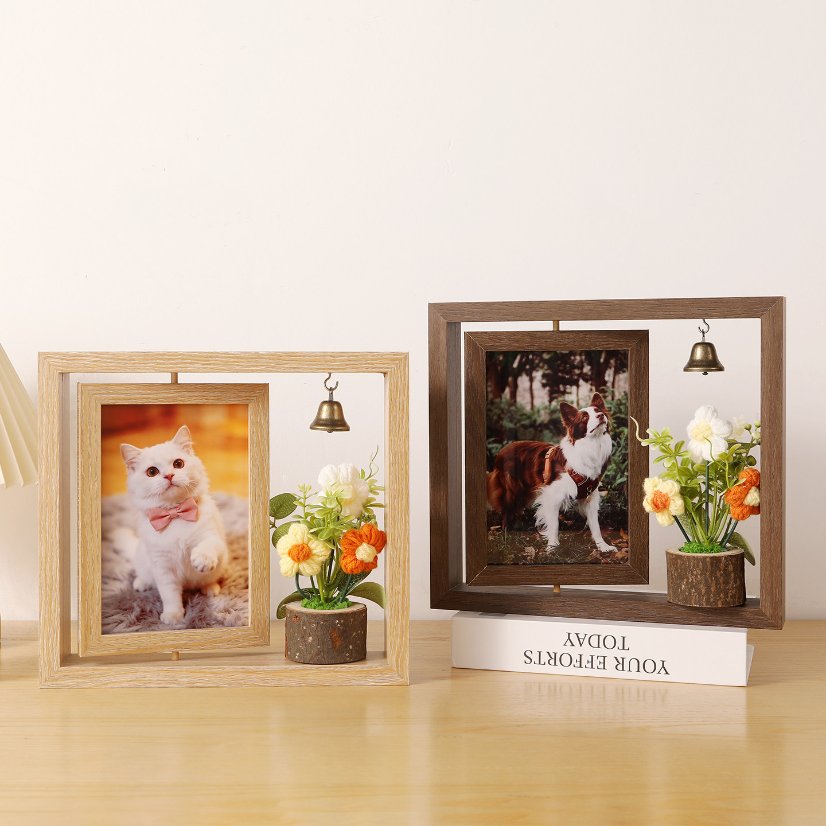
Confirm a rotating-frame spare-parts offer by identifying the complete frame first, naming the requested component and asking whether the supplier actually offers it separately. Keep “offered,” “not offered” and “not yet answered” distinct. A photograph of an assembled frame does not prove that its parts are removable, interchangeable or available as spares. The useful RFQ is a component-specific buying request with a defined offer basis, not an assumed after-sales service.
Identify the complete frame before the requested part
Qeframe’s historical official page names a Double-Sided Rotating Pet Photo Frame. The reused catalogue image shows a wood-grain appearance, an inner display frame and decorative elements. These are visual references; they do not verify material composition or identify a separately supplied parts list. The selected cover is not an exploded drawing. Use the exact catalogue page to locate the discussion, then ask the supplier which version its response concerns.
A buyer may have a returned display, a sample photograph or an older order description. Each can help explain the request, but none should be silently equated with the supplier’s current offer. Record the available frame reference and its limits. If the version is uncertain, make identification the first open question. Ordering a vaguely named “replacement part” before that relationship is clear can produce a quotation that answers a different request.
Name the component without assuming it is a spare
Describe the requested object using a marked reference or a supplier-confirmed component name. If the buyer has only a general photo, label the object being asked about without claiming it can be detached. The supplier should state whether it can identify and offer that item separately. This article gives no disassembly, repair or installation instructions. The request concerns a buying decision and the evidence needed to understand an offer.
Keep a decorative object, a display component and a complete replacement frame as different possible quotation subjects. A supplier answering with a complete frame has not necessarily offered the requested component. Conversely, a component price would not establish that other visible pieces are included. The buyer should ask what the quoted unit actually contains rather than interpreting a short description as a complete parts schedule.
Use an RFQ record that separates the decisions
Record field | Buyer reference to provide | Supplier answer to retain
Complete frame identity | Exact page, order or sample reference available | Which version the response covers
Requested component | Named object or marked callout | Identified, unclear or a different object proposed
Separate supply status | Explicit request for a component-only offer | Offered, not offered or unanswered
Compatibility basis | Existing article reference and open questions | Evidence or limitation actually stated
Quotation unit | Component-only request distinguished from complete frame | Exact offered contents and unit basis
Commercial scope | Questions relevant to the enquiry | Only actual confirmed terms and exclusions
This record can produce a useful result even if the supplier does not offer the part. An explicit “not offered separately” response is different from no answer. Preserve that distinction instead of treating a missing price as proof of refusal or availability. If a substitute is proposed, give it a separate reference and decision rather than describing it as equivalent before the supplier has explained its intended relationship.
Ask what supports a compatibility statement
Compatibility needs an exact subject. Ask which frame version the supplier says the proposed component belongs to and what reference supports that statement. A similar wood-grain appearance or a shared product name does not establish an interchangeable component. If the supplier provides a drawing or identified sample, record what it actually covers. Do not infer dimensions, fixing methods or a functional test from a general catalogue photograph.
Where the buyer’s old article cannot be identified precisely, leave the limitation beside the request. A supplier may need more information before giving a scoped answer. That is a different situation from a confirmed match. The buyer can decide whether the available evidence is sufficient to continue the enquiry without promising that a proposed part will fit, operate correctly or restore a particular function.
Compare a parts offer with a complete-frame alternative
If the supplier offers a whole frame instead, retain it as a separate alternative. Compare the subjects being quoted before comparing any actual commercial terms. A component-only response and an assembled-product response do not describe the same unit. Do not manufacture a comparable price by guessing which other parts or services are included. Record the actual offer scope and ask about unresolved contents.
The same caution applies to a group of parts. A supplier may identify a proposed set, but the buyer should not assume its contents from a product photograph. Link an actual supplied list to the quotation reference when available. Keep unspecified elements open. This makes the purchasing decision clearer without asserting a stock programme, a minimum quantity, a delivery schedule or an ongoing spare-parts arrangement.
Keep the decision separate from earlier frame approvals
Earlier records may concern inspecting both faces, keeping portrait pairs together or approving care-card wording. Those tasks identify different decisions. They do not establish a separately supplied replacement component. Use their reference identities where helpful, but do not transfer their approval status to a new spare-parts proposal. Likewise, acceptance of a parts quotation does not approve material composition, load performance or a repair method.
At the end of the enquiry, record which exact proposal was accepted, declined or left pending. Keep the supplier’s exclusions and compatibility limits beside the decision. A concise file should let another buyer identify the complete frame, the requested object and the actual unit offered. It should not turn a conversation about a visible component into a claim that the supplier provides a repair service or guarantees future availability.
Frequently asked questions
Does an assembled-frame photograph prove that parts are sold separately?
No. It identifies a catalogue product. Ask whether the exact requested component is offered separately and preserve the supplier’s actual response. No spare-parts stock or service is inferred from the picture.
Can a visually similar part be treated as compatible?
Not on appearance alone. Identify the frame version and ask what the supplier’s compatibility statement covers. Keep any uncertainty visible rather than describing an unverified substitute as a confirmed match.
What if the supplier quotes a complete frame instead?
Record it as a different quotation subject. It may be an alternative proposal, but it is not automatically an answer to a component-only request. Clarify its contents and scope before comparing actual terms.
Does this RFQ explain how to repair the frame?
No. It organizes a buying request and an offer decision. It provides no disassembly, installation or repair procedure and establishes no functional, material or performance guarantee for a proposed component.
Send a component-specific enquiry
Use the exact rotating-frame page with the available article reference and a clear component callout. Ask the supplier what it can actually identify and offer. Keep blog context separate from the order-specific quotation and its compatibility evidence.
https://qeframe.com/product/double-sided-rotating-pet-photo-frame/
https://qeframe.com/contact/
https://qeframe.com/blog/