
Grid Frame Hanging: Request the Back-View Map
Request a supplier-marked back-view map for the exact grid-frame variant being quoted. Link each attachment callout to the applicable reference, distinguish included fittings from illustrated features, and ask the supplier to confirm the intended orientation. Leave dimensions, mounting requirements and load limits unconfirmed unless suitable evidence is provided. A catalogue rear-view illustration is a useful reference, not an installation test or a complete supply commitment.
The purchasing goal is a clear map that connects the quoted frame to the supplier response. It should let a reviewer identify which back, which marked location and which fitting the answer concerns. This avoids approving a general statement about a frame family when the order requires confirmation of one particular variant.
Use the exact catalogue reference
The official product reference is Six-grid and seven-grid photo frames:
https://qeframe.com/product/six-grid-and-seven-grid-photo-frames/
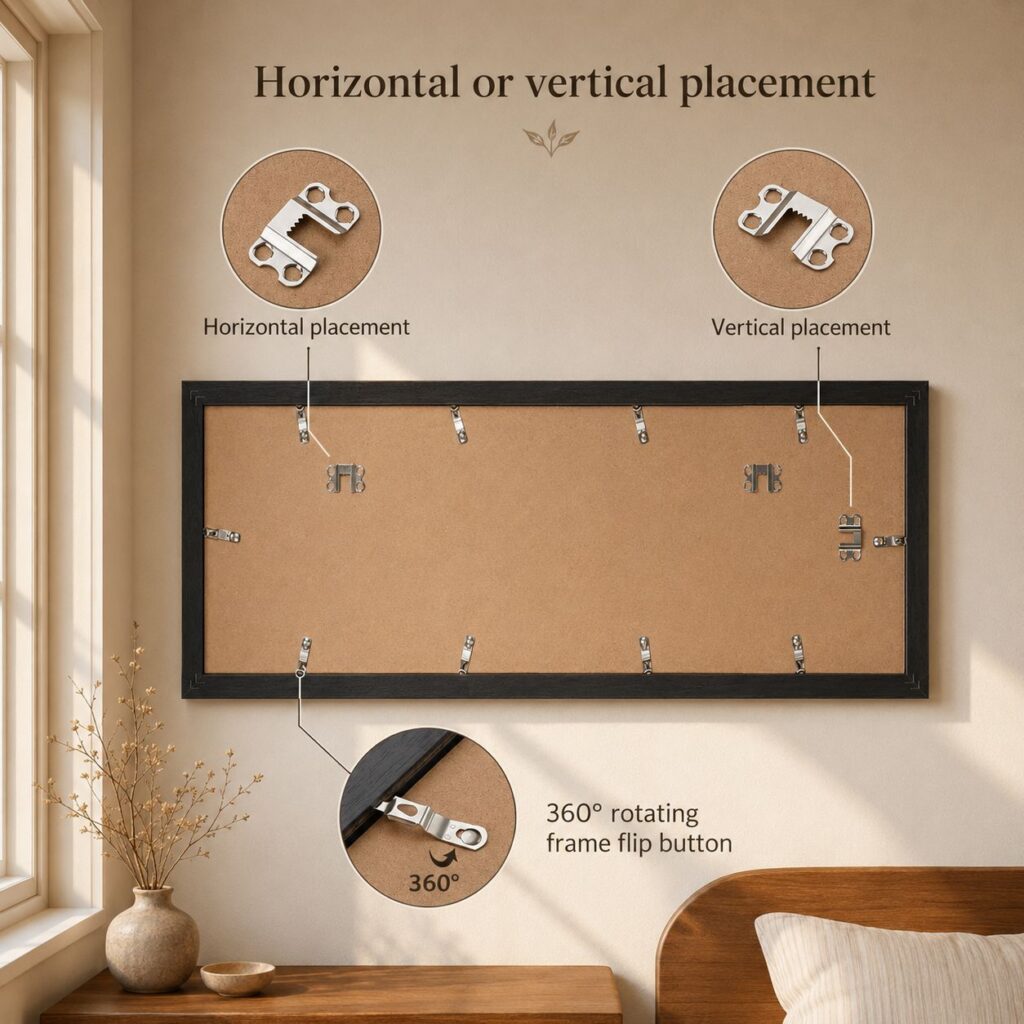
The saved official rear-frame illustration shows retaining features and hanger positions as a catalogue reference. Its relevance is the visible physical rear assembly. It does not prove that every illustrated feature or loose fitting is supplied with the quoted variant, and it provides no verified load or installation result.
Keep the exact product and supplier-confirmed variant name with the quotation line. Treat catalogue grid and size notations as labels until the supplier explains them. This enquiry concerns the back-view reference and attachment supply; it does not establish mat-opening dimensions or resolve an aperture drawing from a product name.
1. Ask which back-view reference applies
Request a photograph or marked drawing that the supplier identifies as applicable to the exact offered frame. Give the reference a revision or another stable identifier. Ask the supplier to state whether it shows the quoted variant, an illustrative family example or a proposed sample awaiting confirmation.
If the catalogue illustration is being used as the starting point, ask which details remain applicable and which need another view. Do not silently transfer a back arrangement from a visually similar frame. When a relevant area is hidden or unclear, request the specific evidence needed to identify it rather than filling the gap from expectation.
2. Establish a shared viewing direction
Have the supplier mark the reference so both parties use the same viewing direction. A left or right callout should have a defined meaning when seen from the back. Ask the supplier to identify the intended display orientation for the exact variant and the reference used to explain it.
Keep orientation questions separate from assumptions about possible positions. A frame shown one way in a catalogue does not confirm every alternative arrangement. Record the supplier response against the marked reference, including any option that remains open. Avoid approving an orientation through an unlabelled screenshot that could be read in more than one way.
3. Map each supplier-confirmed attachment callout
Ask the supplier to label the relevant hanging or attachment locations on the applicable reference. Use the same callout identifiers in the response record. Where a visible feature serves another purpose, ask the supplier to explain that purpose rather than treating every rear component as a hanging point.
Request a supplier answer for each callout that affects the purchasing decision. A general reply such as hardware included should identify the corresponding items and the exact quoted unit. If a fitting is illustrated but not supplied, retain that distinction. Do not infer fixing materials, fastener dimensions or a safe load from the shape of a visible part.
A reusable back-view confirmation record
Variant reference | Back-view revision | Attachment callout | Included or open fitting | Orientation question | Supplier answer
Enter the exact quoted frame | Link the applicable marked view | Use a supplier-defined identifier | Await the quoted supply response | Identify the intended position | Keep open until confirmed
Retain the order-line reference | Link a necessary detail view | Identify the questioned feature | Separate illustrated from included | State an unresolved point | Record the applicable reply
Link the reviewed sample | Retain the approved reference | Preserve the agreed callout | List any exception | Retain the accepted orientation | Name the bounded approval
These rows are instructions for a blank record. They do not state the hardware supplied with the listed frames. Add a row for each supplier-confirmed feature that needs a separate answer.
4. Separate the supplied product from installation requirements
Ask the supplier to identify what accompanies the frame and what must be addressed separately for the intended use. A supplied fitting list should not be read as a complete installation method. Request applicable instructions and limitations from the supplier without inventing a wall type, anchor choice or mounting procedure.
If the buyer has a specific installation requirement, describe it as a requirement for review. Ask what information the supplier can provide for the exact proposed product and what remains unverified. Keep any load, dimensional or fixing-related question open until the necessary evidence exists. The back-view map alone cannot settle those questions.
5. Reconcile the map with an identified sample
When sample evidence becomes available, compare its back with the reference that was used for the supplier response. Identify any visible difference by callout and ask the supplier whether the quoted supply changes. A different photograph should not be treated as an approved revision without an explanation of its relationship to the offered frame.
Preserve the earlier map when a revision is issued. Record which callouts changed, which supply answers remain applicable and which need renewed confirmation. A useful approval names the frame variant, the back-view revision and the bounded supplier responses. It should not imply that an unperformed installation or load check has passed.
Short FAQ
Does the official rear illustration prove that all pictured fittings are included?
No. Ask the supplier to distinguish catalogue illustration features from the actual quoted contents and identify any loose fittings or exclusions.
Can every visible rear feature be treated as a hanging point?
No. Request the supplier purpose and applicable callout for each relevant feature. Do not assign a function from appearance alone.
Does a marked back-view map provide a load rating?
No. It identifies locations and responses. A load or mounting claim needs suitable evidence for the exact product and proposed use, not an inference from a drawing.
What should be retained after approval?
Keep the exact frame and order reference, marked back-view revision, callout responses, supplied-fitting scope and unresolved exceptions together so later changes can be reviewed against the same record.
Request a bounded back-view response
Send QEF the exact grid-frame URL, the quoted variant and the blank confirmation record. Ask for an applicable marked back view, supplier-confirmed callouts, the supplied-fitting scope and any relevant instructions or limitations. Keep the source illustration as a reference while the actual quotation response establishes what is offered.
Contact: https://qeframe.com/contact/
Related buying articles: https://qeframe.com/blog/